
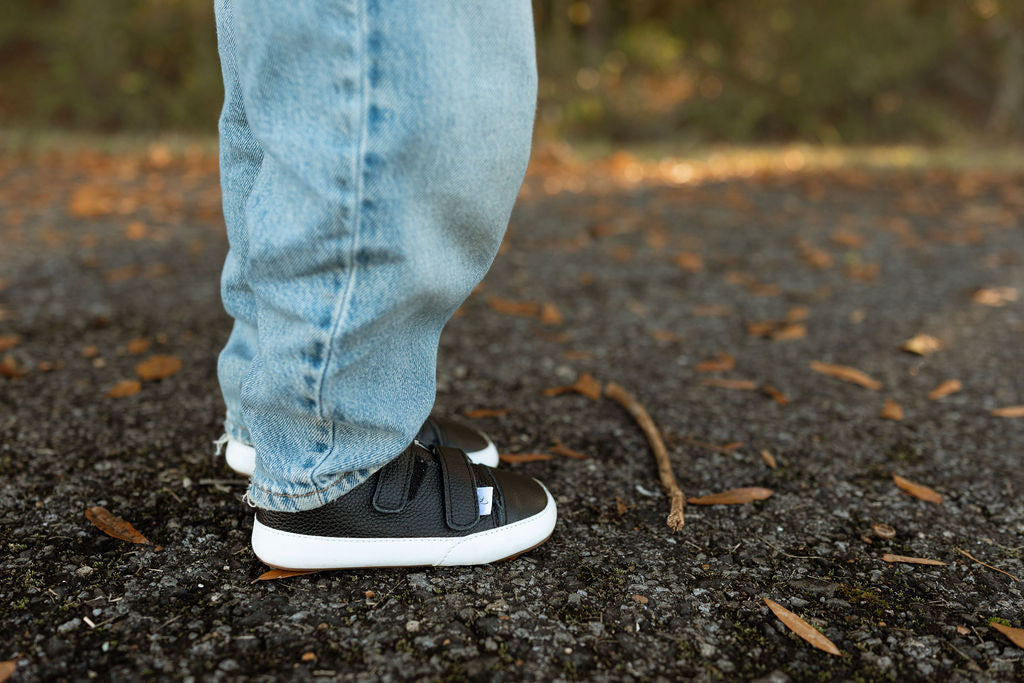
Those first wobbly steps are a big little moment. Suddenly, every trip to the door brings a new question: does my baby need shoes yet? You do not need a special birthday or an age chart to make that decision. Start with where your child will be spending time and what they need for that outing.
This is a practical guide to choosing a first pair, not a rule about when a baby should walk. Every family's days look different. A few simple checks can help you choose shoes that fit the moment.
Think about the place, not a deadline
At home, on a clean indoor surface, you may choose to leave shoes off. Outdoors, a shoe gives you a layer between little feet and the ground. Think about the weather, the surface and the plan for the day: a ride in the stroller is different from a walk around a gravel path.
Check the rules at childcare, play spaces and other places you visit, too. Some ask children to wear shoes or a particular kind of indoor footwear. There is no need to buy a whole shoe wardrobe before you know what your child will actually use.
Choose one useful first pair
A first pair can be wonderfully simple. Look for a roomy toe box, a sole that bends easily and a closure you can adjust. You should be able to open the shoe wide enough to get it on without a struggle, then fasten it so the heel does not keep slipping out.
The Low Top is a lovely place to start. It has a wide opening and double Velcro closure, so you can open it up, settle the foot in and adjust the straps. Check the sole and size information on the product page before choosing your pair. Do not assume that every size uses the same sole.
Measure before you choose a size
A shoe size based on age is only a rough starting point. Two children the same age can wear different sizes, and a size from another brand may not be a direct match.
- Place a piece of paper on a flat floor and have your child stand on it while you help them stay steady.
- Measure from the back of the heel to the longest toe on both feet.
- Use the longer measurement. For Little Love Bug sneakers and boots, add 0.9 cm; for sandals and slip-ons, add 0.5 cm.
- Match that total to our sizing chart, using the chart for the sole you are buying.
If getting a standing measurement is not going well, take a break and try again rather than guessing. Our shoe size guide by age can help you get oriented, but the measurement is what you should use to order.
Try the shoes with their usual socks
Use the socks your child will normally wear. Open the closure fully, guide the foot in and make sure the heel is seated at the back. Socks should lie smoothly rather than bunching up under the toes. Close the straps without pulling them as tightly as possible.
Give your child a little time to move around with you nearby. Watch for a heel that keeps sliding up, a strap that will not close easily, or toes pressing against the front. If something seems off, check the fit again. A bigger shoe is not automatically a more comfortable one.
Keep first outings easy
Try the new pair during a short, familiar outing before planning a whole day in it. Keep the first try relaxed: shoes on, a little exploring, then shoes off when you are home. A spare pair of socks in your bag can be handy after an unexpected puddle.
If your child pulls at the shoes, pause and look inside. A folded sock, a tiny bit of grit or a strap sitting awkwardly may be the whole story. Check the fit instead of assuming they simply dislike shoes.
Check again as the weeks go by
Little feet do not stay the same size for long. Remeasure regularly and anytime a pair becomes harder to put on or seems to leave marks. Avoid buying a much bigger pair just to make it last; a loose shoe can keep slipping off.
When you are ready, browse our barefoot shoes for kids and choose one pair that suits your actual days. First shoes do not have to be complicated. A measured fit, an easy closure and a little patience are a lovely beginning.


